Google Ads Transparency Center alternatives: what it shows and what you lose
Google Ads Transparency Center is free, but on 1 November 2026 it searched only by advertiser name or website, with no spend and no landing-page link. Paid ad-spy tools such as BigSpy (from $159 a month) and PowerAdSpy (from $99) add Google ads; most others in our database do not.
| Route | Google / YouTube ads | Price | Main limit |
|---|---|---|---|
| Google Ads Transparency Center | Search, YouTube, Maps, Shopping, Play | Free | Search by advertiser or website only; no spend for commercial ads |
| Google BigQuery dataset and API | Ads served in the EEA and Türkiye | Free within BigQuery’s 1 TB a month | No US-only ads; needs a Google Cloud project |
| BigSpy | Google Ads and YouTube from the Growth plan | $159 a month (Free plan covers Facebook only) | Not on Free or Starter; all 11 channels need Ultimate at $499 |
| PowerAdSpy | Google Display from Standard; YouTube and Google from Platinum | $99 / $279 a month | Basic ($69) is Facebook and Instagram only |
| Meta Ad Library | None: Facebook and Instagram only | Free | Different network, useful as a second free library |
Where each route stands for Google and YouTube ads. Prices from the vendors’ own pages, read 1 November 2026.
What Google Ads Transparency Center shows for free
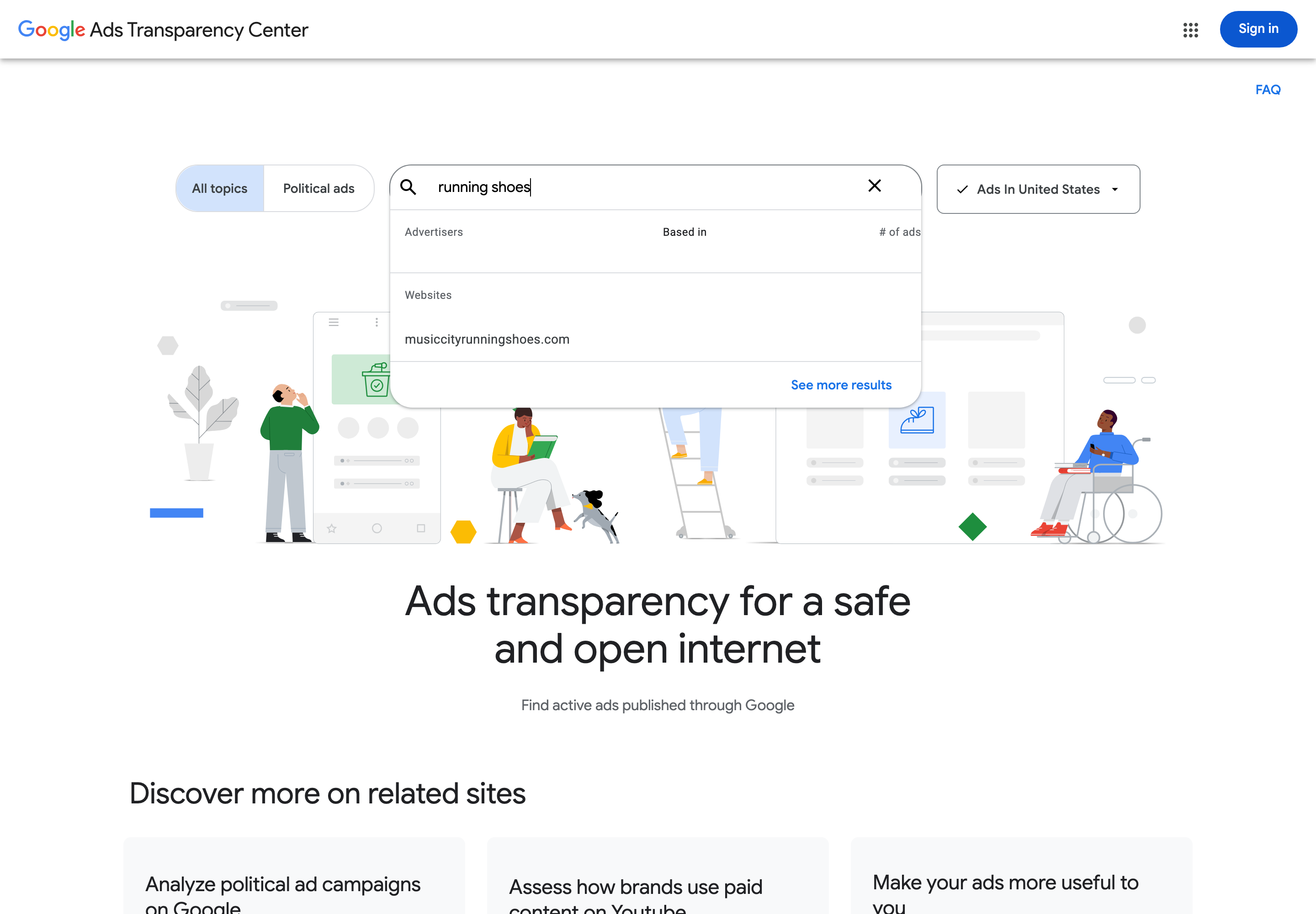
Section titled “What Google Ads Transparency Center shows for free”The Center opens without a sign-in. On 1 November 2026 we searched it from the United States and typed "running shoes" into its only search field. The advertisers block stayed empty and the websites block offered one domain, musiccityrunningshoes.com, a site with those words in its name. The field matches advertiser and site names, not ad text, so you need a list of competitors before you start; it cannot produce one.
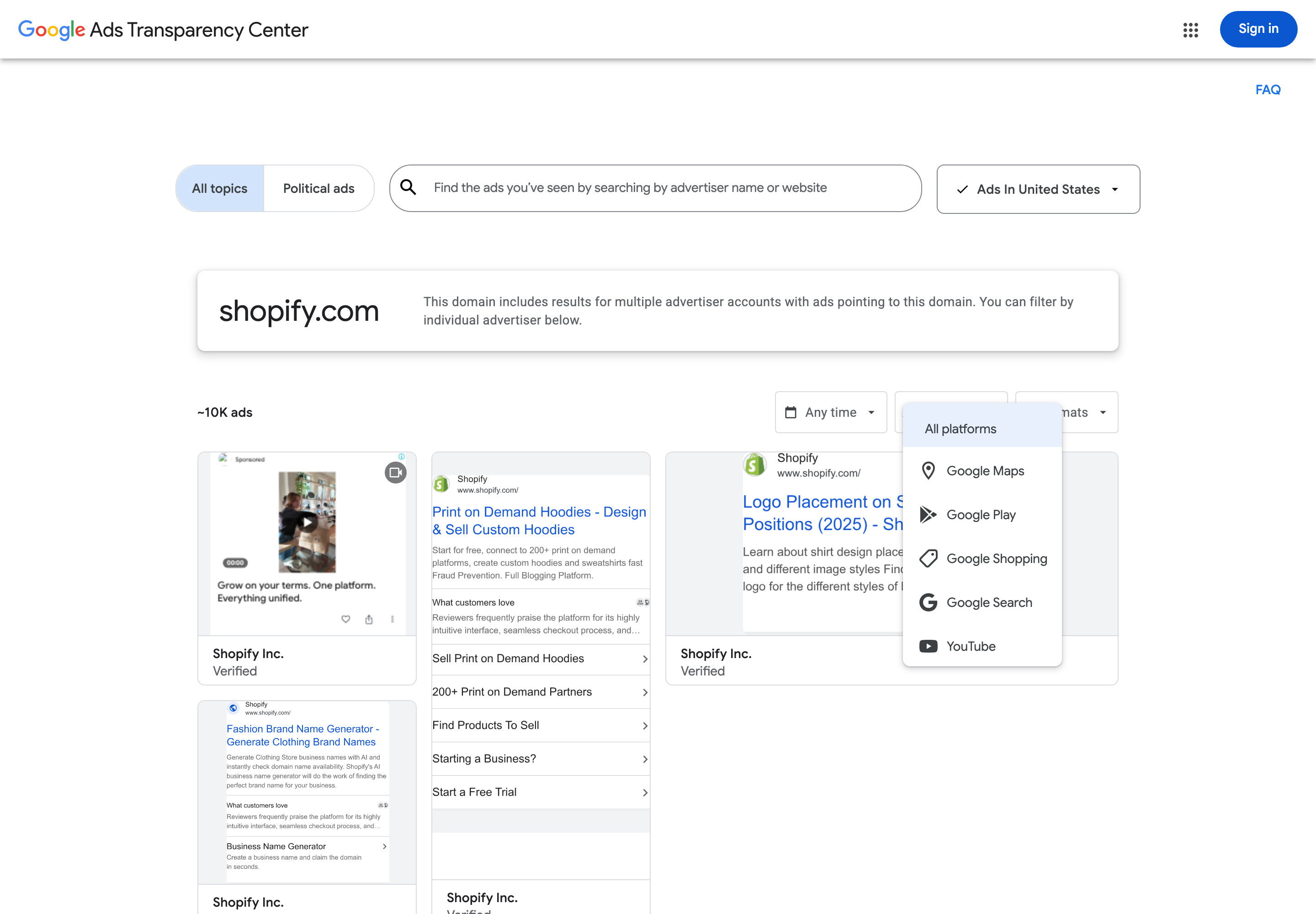
Searching a domain works well. For shopify.com, set to ads in the United States, the Center showed about 10K ads from advertiser accounts labelled "Shopify Inc." and "Verified", with three filters: date, platform and format. The platform filter offers Google Maps, Google Play, Google Shopping, Google Search and YouTube.
The advertiser page: what you can filter
Section titled “The advertiser page: what you can filter”The domain page lists ads as static previews with the advertiser name and a Verified label. Filters narrow it by time, platform and format. That is enough to see which surfaces a competitor uses, for example whether it runs on YouTube or only on Search.
What one ad card gives you, and what it leaves out
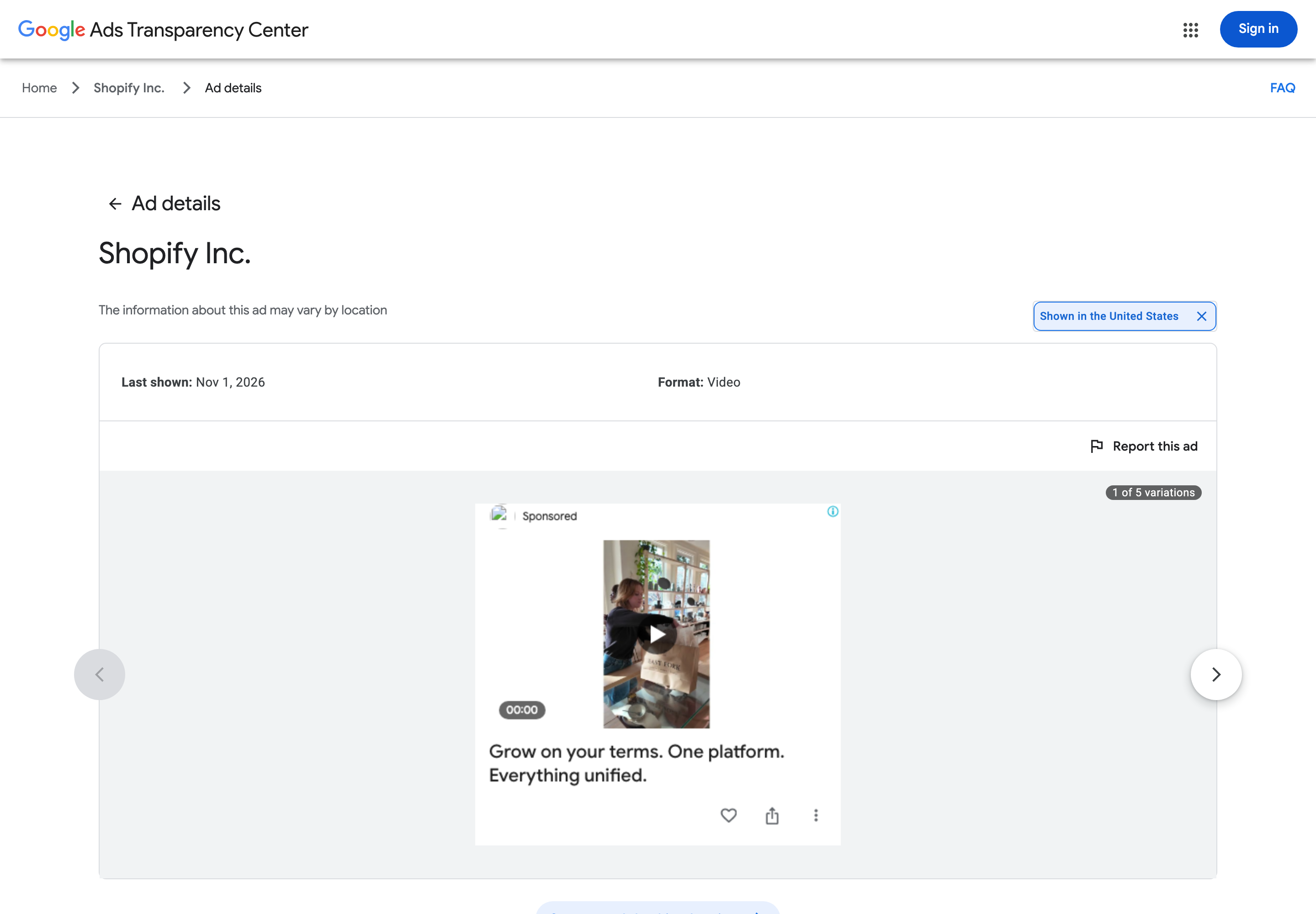
Section titled “What one ad card gives you, and what it leaves out”We opened the first video ad from Shopify Inc. The card shows the ad, the last shown date (1 November 2026), the format (Video) and "1 of 5 variations", plus a Report this ad button. It does not show spend, impressions, a first shown date or a link to the landing page. Google's FAQ explains the gaps: ads are static screenshots and are not clickable, only up to 5 common variations of an ad are shown, and agencies are never named.
For ads served in the EEA and Türkiye the Center adds targeting information, recipient counts and a subject label. Impression ranges are published only after a delay of 90 days, and none exist before 1 March 2023. Commercial ads are kept for one year from the date they were last displayed.
What you lose when you rely on it alone
Section titled “What you lose when you rely on it alone”- No market search. You cannot ask who advertises a product; you must already know the name or domain.
- No spend or run length for commercial ads. You see the last shown date, not how long the ad has been running or what it cost.
- No path to the landing page. The preview is not clickable, so the funnel behind the ad stays hidden.
- One year of history. An ad disappears a year after its last display.
- No bulk export for the US. The API and the BigQuery dataset cover ads served in the EEA or Türkiye only.
Alternatives that add Google ads
Section titled “Alternatives that add Google ads”Free first: the BigQuery dataset behind the Center gives bulk access, but only for the EEA and Türkiye. It needs a Google account and a Google Cloud project and fits in BigQuery's free 1 TB a month. For US ads there is no equivalent.
Among paid ad-spy tools, two in our database state Google coverage. BigSpy's Free plan covers Facebook only; Growth ($159 a month) adds Google Ads and YouTube among other channels, and all 11 channels need Ultimate ($499). PowerAdSpy's Basic plan ($69) covers Facebook and Instagram; Standard ($99) adds Google Display, Platinum ($279) adds YouTube and Google, and all 11 networks sit on Palladium ($399).
The other tools we track do not list Google among their channels: AdSpy and the Meta Ad Library cover Facebook and Instagram, TrendTrack Shopify and Meta, PiPiADS TikTok and Facebook, AdPlexity native and push traffic, Anstrex native, TikTok, push and pops. Spytrend covers Facebook, Instagram and TikTok and is no answer to this question. We have not tested what BigSpy or PowerAdSpy show for a Google ad, so check whether they show spend or landing pages before you pay.
Which one to use
Section titled “Which one to use”- You know the competitor and want to see its Google and YouTube creatives: the Center, free.
- You need EEA data in bulk: the BigQuery dataset.
- You need Google ads inside a paid research tool alongside other networks: BigSpy from Growth or PowerAdSpy from Standard.
- Your competitors are on Facebook and Instagram: the Meta Ad Library searches by keyword, which the Google Center cannot do.
The Center's terms limit use to information or research, so selling or monetizing what you pull from it is not allowed. For how to use the Center step by step, see our Google Ads Transparency Center guide.
Is there an alternative to Google Ads Transparency Center?
Section titled “Is there an alternative to Google Ads Transparency Center?”Yes, in two senses. For bulk data on EEA and Türkiye ads, Google’s own BigQuery dataset is free within 1 TB a month. For Google ads inside a paid research tool, BigSpy covers Google Ads and YouTube from its Growth plan ($159 a month) and PowerAdSpy covers Google Display from Standard ($99), per their pricing pages read on 1 November 2026.
Is there a Google ads library with keyword search?
Section titled “Is there a Google ads library with keyword search?”Not in the Center itself. On 1 November 2026 typing “running shoes” returned no advertisers and only one website with those words in its name, because the field matches advertiser and website names. You must know the competitor first, then search by name or domain.
Can you see how much a competitor spends in Google Ads Transparency Center?
Section titled “Can you see how much a competitor spends in Google Ads Transparency Center?”No for ordinary commercial ads. The ad card showed the last shown date, format and variations only. Amount spent appears, as a range, only in the separate political advertising report. Impression ranges exist for EEA and Türkiye ads and arrive after a 90-day delay.
Is there a YouTube ad library?
Section titled “Is there a YouTube ad library?”The Center is Google’s: its platform filter includes YouTube next to Search, Maps, Play and Shopping, so you can list a known advertiser’s YouTube ads there. Paid tools such as BigSpy (Growth plan) and PowerAdSpy (Platinum plan) also list YouTube among their channels.
Is Google Ads Transparency Center free?
Section titled “Is Google Ads Transparency Center free?”Yes. It opened without a sign-in on 1 November 2026; Google asks for one only for age-restricted ads. Its terms allow use for information or research purposes only, so selling or monetizing the content is not allowed.